What Is Square Footage?
Square footage is a measurement of two-dimensional area. It tells you how much flat surface a space covers. One square foot is a square that measures exactly 1 foot on each side.
When you calculate the square footage of a room, you determine how many of these 1-foot × 1-foot squares would fit across the floor. Square footage is the standard unit of area measurement in the United States for real estate, construction, flooring, painting, and landscaping.
The term “square” in square foot refers to the mathematical concept of multiplying a measurement by itself or by another measurement — not to the shape of the room. The word “foot” is a unit of length, not a body part. These clarifications help avoid confusion when reading property descriptions or contractor estimates.
Square Foot Formula
The basic formula to calculate square footage is:
Every part of this formula represents a specific value:
- Length = one dimension of the space (the longer side of a rectangle)
- Width = the other dimension (the shorter side)
- Result = area in square feet, when both measurements are in feet
This is the area formula used for any rectangular or square space. The result represents the total floor area, wall area, or any other flat surface you are measuring.
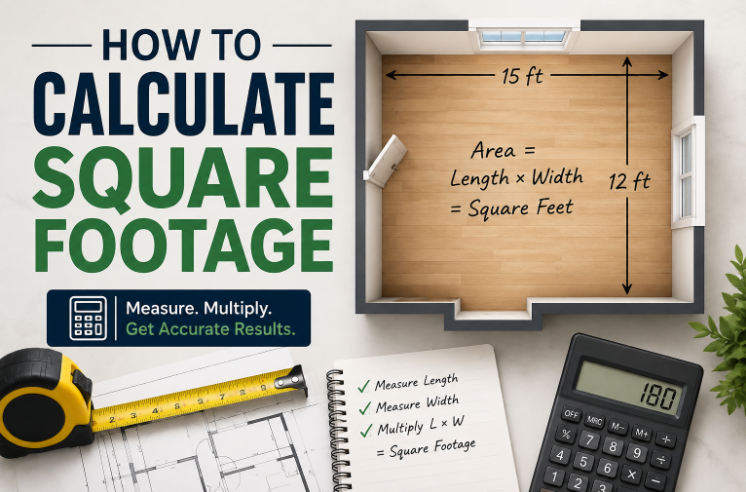
A room measures 15 ft long and 12 ft wide.
The room has an area of 180 square feet.
How to Calculate Square Footage Step by Step
Follow these steps to calculate the square footage of any rectangular space:
- Measure the length. Use a tape measure to find the longest dimension of the space. Hook the tape on one end and extend it to the opposite side. Record the measurement in feet.
- Measure the width. Measure the adjacent side of the space from wall to wall. Record the measurement in feet.
- Make sure both measurements use the same unit. If one measurement is in feet and the other in inches, convert them to the same unit before calculating.
- Multiply length by width. Use a calculator or multiply on paper: Length × Width = Area.
- Label the result in square feet. Write the answer as “sq ft” or “ft²” to indicate that this is an area measurement, not a length.
- Double-check the measurements. Re-measure both dimensions to confirm accuracy. A small error in measurement can lead to significant material waste or shortage.
When using a tape measure, keep the tape level and taut. Measurements should normally be taken from finished wall surfaces for interior spaces. For exterior or construction measurements, specific standards may apply depending on the purpose of the calculation.
How to Measure a Room
Measuring a room for square footage requires a tape measure (or laser measurer), a notepad, and a pencil. Here is how to measure a room accurately:
- Clear the perimeter. Move furniture away from walls to get an unobstructed measurement line.
- Start at one corner. Hook the tape measure at the base of the wall and extend it to the opposite corner.
- Read the measurement at floor level. The tape should follow the floor, not angle upward.
- Record length and width separately. Write each measurement down immediately.
- Measure twice. Always take a second measurement to confirm the first one.
For rooms larger than your tape measure, mark a point on the floor, measure to that mark, then continue from the mark to the far wall. Add the two measurements together.
Square Footage Examples
Here are three common room size calculations:
Measurements: 10 ft × 10 ft
This 100-square-foot room is a typical small bedroom or home office.
Measurements: 12 ft × 15 ft
A 180-square-foot room comfortably fits a queen bed, dresser, and nightstands.
Measurements: 20 ft × 14 ft
At 280 square feet, this living room has space for a sofa, chairs, coffee table, and entertainment center.
How to Calculate an Irregular Room
Not every room is a perfect rectangle. Many rooms have alcoves, bump-outs, closets, or angled walls. The method for calculating square footage of an irregular room is straightforward:
- Divide the space into smaller rectangles. Sketch the room on paper and draw lines to separate it into simple rectangular sections.
- Calculate the square footage of each section. Multiply length × width for each rectangle.
- Add the individual areas together. The sum is the total square footage.
A room has a main area and a small alcove:
Section A (main area):
Section B (alcove):
Total:
This method works because you are simply adding the flat areas of the sub-sections. Each section is a rectangle with its own length and width.
For unusually complex shapes — curved walls, multi-angled rooms, or rooms with many bump-outs — more detailed measurements or professional measurement may be necessary. Use our Odd Shapes Calculator to automate this process.
How to Calculate Square Footage of an L-Shaped Room
An L-shaped room is one of the most common irregular layouts. To calculate square footage, divide the L into two separate rectangles:
- Identify where the L-shape bends.
- Draw an imaginary line across the bend to create two rectangles.
- Measure the length and width of each rectangle.
- Calculate the area of each rectangle.
- Add both areas together.
An L-shaped living-dining area:
Rectangle 1 (living area): 14 ft × 12 ft
Rectangle 2 (dining area): 10 ft × 8 ft
Total L-shaped room:
Use our Room Calculator or Odd Shapes Calculator for L-shaped rooms with more than two sections.
Triangular and Circular Areas
The basic length × width formula does not apply to every shape. Here are the formulas for triangles and circles:
Triangle
Measure the base (the bottom edge) and the height (the perpendicular distance from the base to the top point). Multiply the base by the height, then divide by 2.
Base = 10 ft, Height = 8 ft
Use our Triangle Calculator for detailed triangle area calculations.
Circle
Measure the radius (the distance from the center to the edge). Square the radius, then multiply by π (approximately 3.14159). If you know the diameter, divide it by 2 to get the radius.
Radius = 5 ft
The result is measured in square feet, just like a rectangle. Use our Circle Calculator for circular area calculations.
How to Calculate Square Footage in Inches and Feet
When measurements are given in inches, you must convert them to feet before using the square foot formula. The conversion is simple:
Divide any inch measurement by 12 to get feet.
A room is 180 inches long and 144 inches wide.
Convert to feet:
Calculate area:
If you multiply inches by inches, the result is square inches, not square feet. To convert square inches to square feet, divide by 144 (because 12 × 12 = 144).
1 square foot = 144 square inches
For measurements that mix feet and inches (e.g., 10 feet 6 inches), convert the inches portion to a decimal fraction of a foot: 6 ÷ 12 = 0.5 feet. The total length is 10.5 feet. Use our Feet & Inches Calculator for separate input fields.
Square Feet vs. Linear Feet vs. Cubic Feet
Understanding these distinctions is important when ordering materials. Linear footage measures length only — useful for trim, baseboards, and fencing. Square footage measures area — required for flooring, paint, and tile. Cubic footage measures volume — needed for concrete, fill dirt, and mulch.
Do not confuse linear feet with square feet. A 12-linear-foot piece of crown molding is a length measurement. A 12-square-foot section of flooring is an area measurement. They represent fundamentally different quantities.
Imperial and Metric Measurement Systems
Imperial System
The Imperial System uses feet and inches as primary length units. Area is expressed in square feet (ft²) or square inches (in²). This system is standard in the United States for property measurement, construction, and real estate.
Metric System
The Metric System uses meters and centimeters as primary length units. Area is expressed in square meters (m²) or square centimeters (cm²). This system is standard in most countries outside the United States.
Important: Both measurements must use the same unit before calculating area. You cannot multiply feet by meters directly. Convert all measurements to one system first.
- 1 foot = 0.3048 meters
- 1 meter = 3.28084 feet
- 1 square foot = 0.0929 square meters
- 1 square meter = 10.764 square feet
Use our Square Feet to Square Meters Converter for instant unit conversion.
Area vs. Perimeter
Area tells you how much surface space a floor, wall, or lot contains. Perimeter tells you the total distance around the boundary of the space.
For a rectangle:
A room is 12 ft long and 10 ft wide.
You need the area (120 sq ft) to buy flooring. You need the perimeter (44 ft) to buy baseboards.
Confusing area with perimeter is one of the most common square footage mistakes. Adding dimensions (12 + 10 = 22) gives you half the perimeter, not the area. Always multiply length by width for area.
How to Calculate the Square Footage of a House
To estimate the total square footage of a house, measure each room individually and add the results together:
| Room | Dimensions | Area |
|---|---|---|
| Living Room | 20 × 10 ft | 200 sq ft |
| Bedroom | 15 × 10 ft | 150 sq ft |
| Kitchen | 12 × 10 ft | 120 sq ft |
| Bathroom | 10 × 6 ft | 60 sq ft |
Simply adding room measurements may not equal an official property measurement. Different standards can define what spaces are included — for example, hallways, closets, and staircases may or may not count depending on the measurement method and jurisdiction.
For property transactions, professional measurement is recommended. Use our House Calculator to estimate room-by-room square footage for planning purposes.
Types of Square Footage
Several terms describe different ways to measure and report square footage. Definitions can vary by context, property type, industry standard, lease terms, or jurisdiction.
- Livable Square Footage — The interior space that is finished, heated, and suitable for year-round living. Depending on the measurement standard, this typically excludes garages, unfinished basements, and attics.
- Gross Square Footage — The total area of a building measured from the exterior walls. Includes all floors, common areas, and structural elements.
- Rentable Square Footage — Used in commercial real estate, this includes the tenant’s usable space plus a proportional share of common areas (lobbies, hallways, restrooms).
- Usable Square Footage — The space exclusively occupied by a tenant. Does not include shared common areas.
When comparing properties or evaluating lease agreements, always clarify which type of square footage is being referenced. A 1,000 sq ft “rentable” space is not the same as a 1,000 sq ft “usable” space.
Common Square Footage Calculation Mistakes
Avoid these frequent errors when calculating square footage:
- Mixing feet and inches. Convert all measurements to the same unit first. Divide inches by 12 to get feet.
- Forgetting to convert units. If one dimension is in meters and the other in feet, the result will be incorrect. Convert before multiplying.
- Using linear feet instead of square feet. Linear feet measure length only. Square feet require multiplying two dimensions.
- Measuring only one section of an irregular room. Divide the entire room into rectangles and calculate each section.
- Rounding measurements too early. Keep full precision until the final answer, then round.
- Adding dimensions instead of multiplying. Length + width gives half the perimeter, not the area. Always multiply.
- Confusing area with perimeter. Area is length × width. Perimeter is the distance around the boundary.
- Assuming every property uses the same measurement standard. Livable, gross, rentable, and usable square footage are different measurements.
- Measuring inaccurately with a tape measure. Keep the tape level, taut, and flush against the surface. Read at eye level.
Square Footage Calculator
A square footage calculator simplifies the math by accepting length and width inputs and returning the result instantly.
How it works:
- Enter the length of the space.
- Enter the width of the space.
- The calculator multiplies length × width and displays the total area in square feet.
Enter your room dimensions into our Square Footage Calculator to get the result instantly. Our calculator supports rectangles, circles, and triangles, and converts results to square meters, square yards, square inches, and acres.
For specialized projects, try these calculators:
- Room Calculator — calculate room area with presets for bedrooms, kitchens, and bathrooms
- Flooring Calculator — includes waste factor for hardwood, laminate, vinyl, and carpet
- Wall Calculator — deducts door and window areas and estimates paint gallons
- Odd Shapes Calculator — combines multiple rectangles, triangles, and circles
Quick Reference Table
| Shape / Space | Formula | Example | Result |
|---|---|---|---|
| Rectangle | Length × Width | 15 × 12 | 180 sq ft |
| Square | Side × Side | 10 × 10 | 100 sq ft |
| Triangle | ½ × Base × Height | 10 × 8 ÷ 2 | 40 sq ft |
| Circle | π × Radius² | r = 5 | ≈78.54 sq ft |
| L-Shaped Room | Area 1 + Area 2 | (14×12) + (10×8) | 248 sq ft |
Frequently Asked Questions
The formula is: Area = Length × Width. Measure both dimensions in feet and multiply them together. For example, a 12-foot by 10-foot room has an area of 120 square feet (12 × 10 = 120 sq ft).
Measure the length and width of the room in feet, then multiply. A room that is 15 feet long and 12 feet wide has an area of 180 square feet (15 × 12 = 180 sq ft). Use a tape measure for accurate results.
A 10 × 10 room is exactly 100 square feet. Multiply 10 by 10 to get the area. This is a common size for a small bedroom or home office.
Convert inches to feet by dividing by 12, then multiply length by width. A room 10 feet 6 inches long is 10.5 feet (6 ÷ 12 = 0.5). Multiply 10.5 × 8 = 84 square feet. Use our Feet & Inches Calculator for separate input fields.
Divide the room into smaller rectangles. Calculate the area of each rectangle (length × width), then add all areas together. For example, a room with a main area of 10 × 12 ft (120 sq ft) and an alcove of 8 × 6 ft (48 sq ft) totals 168 sq ft.
Divide the L into two rectangles. Calculate each rectangle’s area using Length × Width, then add both areas together. For example, if one section is 14 × 12 ft (168 sq ft) and the other is 10 × 8 ft (80 sq ft), the total is 248 sq ft.
Square feet measure two-dimensional area (length × width). Linear feet measure one-dimensional length only. A 10-foot board is 10 linear feet. A 10 × 10 room is 100 square feet. They measure fundamentally different things.
Square feet measure two-dimensional area. Cubic feet measure three-dimensional volume. A 10 × 10 room is 100 sq ft. With an 8-foot ceiling, it has 800 cubic feet of volume (10 × 10 × 8 = 800).
Measure each room individually using Length × Width, then add all room areas together. For example: Living room (200 sq ft) + Bedroom (150 sq ft) + Kitchen (120 sq ft) + Bathroom (60 sq ft) = 530 sq ft. Official property measurements may differ based on the standard used.
Yes. Multiply length by width on paper or mentally. For simple numbers like 10 × 12, the answer is 120 sq ft. For measurements with decimals or larger numbers, a calculator reduces the chance of errors.
For most home improvement projects, measuring to the nearest inch is sufficient. For material estimates, add a 10–15% waste factor. For construction, legal, or appraisal purposes, professional measurement may be required for the necessary precision.
Usable square footage is the space a tenant occupies exclusively. Rentable square footage includes the usable area plus a proportional share of common areas (lobbies, hallways, restrooms). Definitions vary by lease terms, property type, and jurisdiction.
Final Takeaway
Calculating square footage comes down to one simple formula: Length × Width = Square Footage. Measure both dimensions in feet, multiply them together, and label the result in square feet.
For rectangular rooms, the calculation takes seconds. For irregular or L-shaped rooms, divide the space into rectangles, calculate each area, and add them up. Always use the same unit for both measurements, and double-check your numbers before purchasing materials or listing a property.
Use our free Square Footage Calculator to calculate the area of any space instantly. For specialized projects, explore our Flooring, Wall, Room, and House calculators.